Mysore is a land of million aromas. The aroma of incense sticks or agarbathi's is one that has both religious as well as asthetic appeal. Apart from the incense sticks many variants such as doopa's etc.. are also made in Mysore.
The cycle brand agarbathi is a pioneer in incense sticks. Owned by
N RANGA RAO & SONS it is involved in manufacture of incense sticks not only for india but also abroad. It is situated in Mysore with branch offices in various cities. The fact that Mysore is still the leader in the manufacture of incense sticks is proven beyond doubt by this very fact.
The hand rolled, incense sticks, provide employment to numerous people as it is a labor intensive industry. The huge base of workers in Mysore and surrounding areas provides the right atmosphere for such an industry. The variety provided by these incense sticks is diverse.
Showing posts with label history. Show all posts
Showing posts with label history. Show all posts
Sunday, February 25, 2007

Saturday, December 16, 2006
Mysore Damascus sword
 Was Damascus sword made of Indian steel? Did wootz steel originate in Mysore? Or that the gift King Porus gave to Alexander in the fourth century BC was Ferrum Candidum, believed to be steel? Or that Pliny, writing in the first century BC, says that iron was imported from ‘‘Seres’’ (Cheras)? The list of surprising facts is endless. What is shocking is that we Indians know so little about such an important ancient industry of India.
Mysore wootz steel: Wootz is the anglicized version of ukku in the languages of the states of Karnataka, and Andhra Pradesh, a term denoting steel. Literary accounts suggest that the steel from the southern part of the Indian subcontinent was exported to Europe, China, the Arab world and the Middle East. India has been reputed for its iron and steel since ancient times. Literary accounts indicate that steel from southern India was rated as some of the finest in the world and was traded over ancient Europe, China, the Arab world and the Middle East. Studies on wootz indicate that it was an ultra-high carbon steel with 1-2% carbon and was believed to have been used to fashion the
Damascus blades with a watered steel pattern.
Wootz steel also spurred developments in modern metallographic studies and also qualifies as an advanced material in modern terminology since such steels are shown to exhibit super-plastic properties.In India till the 19th century swords and daggers of wootz steel were also made at centres including Lahore, Amritsar, Agra, Jaipur, Gwalior, Tanjore, Mysore, Golconda etc. although none of these centres survive today. Different types of Damascus swords have been identified in Salr Jung museum in Hyderabad.
The English word steel and the German Stahl are derived from Stahal in Old High German (~l1th century AD) and contain the reconstituted Indo-European root *sta which can be found in the German verb "stehen /stand" or in English "to stand", and related to the Sanskrit stakati, which means: "it resists". The same root is used in Nordic languages and in modem Russian, Polish, etc. In Celtic languages the same root is generally used, e.g., stailin but other words meaning force or hardness are also found, e.g., dir in Breton.
A major problem in doing scientific experiments on wootz Damascus steel is the inability to obtain samples for study. Such study requires that the blades be cut into sections for microscopic examination, and small quantities must be sacrificed for destructive chemical analysis. A rare example where museum-quality wootz Damascus blades were donated to science for study is reported in the 1924 .
The sword blanks and cakes of ukku wootz were exported in large numbers. Aristotle reportedly commented on its qualities. Some say it dates from around 500 AD. while others say it is far older. But the technology seems to have dwindled and vanished by early 1700's.
But history proclaims that wootz steel came from Mysore and few other southern parts of India.
It means that from yore ,Mysore has had inventions that we could be proud of.Is it sufficient to be proud or do something worthwhile?
Saturday, November 11, 2006
The curse on the mysore Maharajas
A curse is a very horrible thing that can happen to anybody. It is more so when a king is cursed as his entire kingdom suffers. Legend has it or hisotry may have witnessed it-Long ago when the mysore rajas invaded and killed one of the pallegaras, the wife of that chieftain is said to have cursed the kings. The curse has three parts:
- Let Thalkad become a desert
- The king shall have no children
- Let the great river have a whirlpool.
Yes talkad is indeed a desert. Although situated on the banks of a river, sand fills the entire region. Eucalyptus trees grow everywhere.And the second part also seems to be true as the kings adopt a relative as a son.The third part which is rather general can be interrpreted in many ways.
Tuesday, October 24, 2006
Ganduberunda-mythological bird of mysore wodeyars
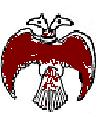
'Ganduberunda' is a mythical bird that is the royal emblem of the royal family of Mysore, the wodeyars. Later on after independence the government of Karnataka has taken up the same symbol as the emblem for state government. The bird which was present in the flag of the erstwhile kingdom og Mysore is known to be a very very strong bird capable of lifting even elephants. The uniqueness of the bird is that it has two heads with a single body.The bird can be found in many carvings in temples and even in the palace. I hope to put up a picture of the same along with the legend behind it in a separate post. The emblem is also present on the KSRTC bus service. This is a state run bus service and has the bird as its logo. The picutre of the bird can be found in the tickets issued by the bus service. The bird is shrouded in mystery due to its mythical and magical prowess. The bird is also known by other names such as 'Gandaberunda' or 'Gunda Berunda' just 'Berunda'. Some claim that the bird is an eagle which had two heads. The bird is supposed to have been visible only to the maharaja of mysore. Later during the British rule, the symbol was used as part of a badge with the motto 'i will defend the right'. Many such gifts were given to the RAF during the world war. You can find details at http://www.bharat-rakshak.com/IAF/History/1940s/Presentation.html
I am reminded of the folk-story of a two headed bird.The two headed bird was living in a forest.One of the head comes across a very sweet and juicy fruit, but instead of sharing it with the other head it eats it up alone. The other head overcome by jealosy, goes in search of a poisonous fruit and eats it up. The two headed bird then dies of the poison. Well the moral of the story is 'think before you act'. The action of the bird in its jealous rage got it killed. Mostly this is a story from the panchatantra or some subashita.
Mysore-Legend behind the name
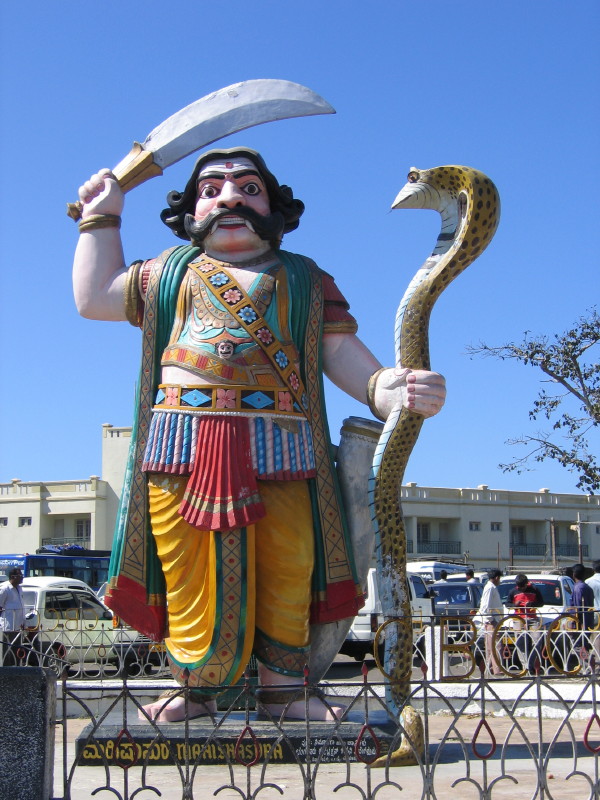
Every name of indian origin generally has meaning attached to it. The name of Mysore is no exception.
The word 'Mysore' which is the anglised version of mysooru is based on the mythological demon Mahishasura. Mahishasura is belived to have been residing at this place. And when he became very powerful he started tormenting the humans residing in the area.His atrocities became unbearable and the people prayed to the gods for mercy. The godess Durga blessed with various weapons of the gods descended to the bhuloka (earth) to vanquish the demon. This avatara of the godess is known by the name 'Chamundeshwari' or 'Mahishasura Mardini', meaning the vanquisher of the demon Mahishasura. The godess is known to have killed the demon and brought peace to the people. The Chamundeshwari temple atop the Chamundeshwari hill is a place of pilgrimage. A idol of the godess is present in the temple, which is considered to be having the spirit of the godess. The picture shows the statue of Mahishasura present on the hill. This is present near the entrance leading to the temple complex. A more detailed post on the various places of interest on the hill will be put up shortly.To mention a few you could also visit the Nandi statue, the temples of various other deities present in the same premises.
Wednesday, October 18, 2006
Mysore Palace-The Grandeur of Mysore
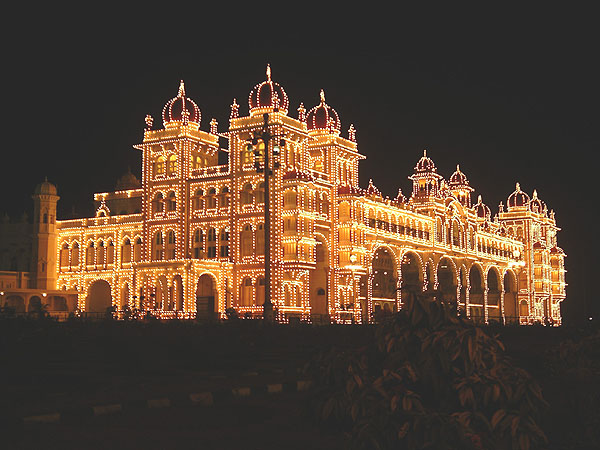
Mysore is known as the city of palaces. But when some body refers to the mysore palace the reference is to the Amba vilas palace. This is also called the main palace. The significance of this palace can be appreciated by knowing that the world renowned Dassara procession starts from here. The current palaces was built as the previous palace got burnt in a fire. To know more about the palace, its architectural history and interiors check out
http://en.wikipedia.org/wiki/Mysore_Palace
The debris from the palace that was gutted in the fire was dumped in the fields surrounding the outter extremes of the city. This has now become part of the extension layouts. More about the effect of these debris on the gardens of these areas in a latter post.
The above picture of the palace taken at the night can be seen only during the days leading upto the the Dassara festival and few days there after. The Lighting is removed during rest of the year.
Subscribe to:
Posts (Atom)
